Utah's 2026 Test Scores Are Out: What Lehi Parents Should Know About RISE Results
Utah's 2026 statewide test results are out, and the headline is good news: scores went up in every core subject, and science hit a record high.
The Utah State Board of Education (USBE) released the 2025–2026 results on September 13, 2026. If your child took the RISE test last spring, you may be looking at a score report right now and wondering what it actually tells you.
This guide covers what the new numbers show, how to read your child's RISE report, and what Lehi parents can look for beyond a single test score.
Key Takeaways
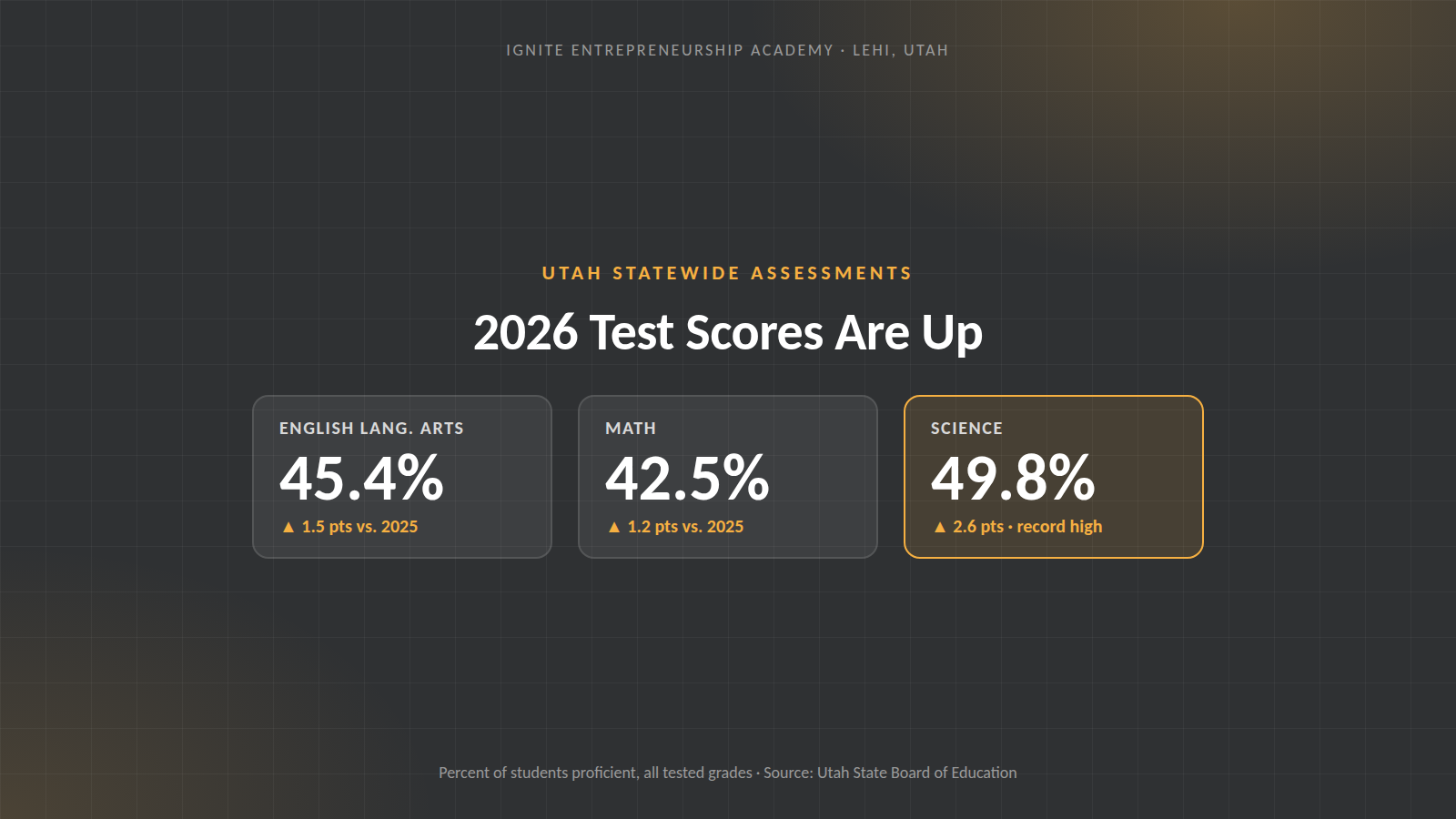
- Scores rose in all three core subjects. Statewide proficiency reached 45.4% in English language arts (ELA), 42.5% in math, and 49.8% in science.
- Science set a record. The 49.8% science proficiency rate is the highest since the 2019 baseline, and grades 3–8 reached 52.3%.
- ELA and math are still recovering. Both are up from 2025 but remain below 2019, pre-pandemic levels.
- Fewer than half of Utah students in grades 3–8 are proficient in ELA or math. That's 45.3% and 45.4%, respectively.
- A test score is one data point. Pair it with your child's classwork, teacher feedback, and how engaged they are in learning.
What Are the 2026 Utah Test Results?
Each spring, Utah students take statewide assessments that measure how well they've mastered grade-level standards. Here's how 2026 compares with earlier years across all tested grades:
| Subject | 2019 (pre-pandemic) | 2021 (low point) | 2025 | 2026 |
|---|---|---|---|---|
| English language arts | 46.8% | 43.1% | 43.9% | 45.4% |
| Math | 44.6% | 39.0% | 41.3% | 42.5% |
| Science | 47.0% | 43.8% | 47.2% | 49.8% |
Source: Utah State Board of Education, 2025–2026 statewide assessment results.
The state described the one-year gains of 1.2 to 2.6 percentage points as sustained, healthy progress. In other words, Utah students are steadily climbing back from pandemic-era learning loss, and in science they've now passed where they were before it.
How Did Elementary and Middle School Students Do?
For K–8 families, these are the numbers that matter most.
Grades 3–8 (RISE)
- ELA: 45.3% proficient
- Math: 45.4% proficient
- Science: 52.3% proficient, with sixth graders approaching 60%
Kindergarten–3rd Grade (Early Literacy and Numeracy)
- Reading: 70.6% of students scored at or above benchmark on end-of-year assessments
- Early math: 65.1% scored at or above benchmark
High School, for Context
Proficiency drops off in high school. On Utah Aspire Plus (grades 9–10), 34.5% of students were proficient in math. On the ACT, 62.3% of 11th graders scored 18 or higher.
That high school math number is worth noticing if you have younger kids. The habits and foundations students build in elementary and middle school—like number sense, persistence on hard problems, and confidence with math—carry forward into those later grades.
What Is the RISE Test?
RISE (Readiness Improvement Success Empowerment) is Utah's end-of-year assessment for grades 3–8. It covers English language arts and math in grades 3–8, science in grades 4–8, and writing in grades 5 and 8.
RISE is computer-adaptive, which means question difficulty adjusts based on how a student is answering. That's why your child's report shows a scale score rather than a simple percentage correct.
How to Read Your Child's RISE Score Report
Your child's Individual Student Report places them in one of four proficiency levels:
- Below Proficient: Does not yet show an understanding of grade-level standards and needs substantial support.
- Approaching Proficient: Shows partial understanding and is close to meeting grade-level standards.
- Proficient: Shows a solid understanding of grade-level standards and handles grade-level work with minimal help.
- Highly Proficient: Shows an advanced understanding and works independently using higher-level thinking.
"Proficient" and "Highly Proficient" count toward the statewide proficiency rates above.
You can typically find your child's report through your school's parent portal, or you can request it from the school. USBE's family resources at utahrise.org include sample tests and tutorials.
5 Questions to Ask About Your Child's Score
A score report is most useful as a conversation starter. Here are questions to bring to your child's teacher:
- Does this match what you see in class? A single test day can be affected by nerves, sleep, or a rough morning.
- Where did my child grow? Compare this year's scale score with last year's. Growth often says more than a proficiency label.
- Which specific skills need attention? Ask what the next step looks like, not just what the gap is.
- How is my child doing with focus, independence, and effort? These skills don't show up on a standardized test, but they drive long-term learning.
- What can we do at home? Ask for one or two concrete activities, not a stack of worksheets.
What Test Scores Can't Tell You
Statewide tests measure an important thing: whether students have mastered grade-level standards in core subjects. But they don't measure everything that predicts a child's success.
A RISE score won't tell you whether your child:
- Can manage their time and follow a project through to the finish
- Recovers well from mistakes and tries again
- Collaborates with classmates and communicates ideas clearly
- Asks good questions and stays curious
- Actually enjoys learning
These are the executive function skills and habits that researchers and employers consistently point to. They also tend to lift academic results, because engaged kids learn more. (We've written about the hidden cost of boredom in school and why disengagement shows up in outcomes.)
How Ignite Approaches Academics
At Ignite Entrepreneurship Academy, a tuition-free K–8 public charter school in Lehi, we care about strong academics and about the skills a test can't capture. We see those as connected, not competing.
Here's how that shows up in a school day:
- Hands-on, project-based learning. Students apply reading, writing, and math to real problems, which helps concepts stick.
- Montessori-inspired classrooms. Children work at their own level and build independence along the way.
- Longer learning blocks. Uninterrupted time lets students go deeper instead of switching tasks every 45 minutes.
- Entrepreneurship. Especially in 7th and 8th grade, students build and pitch real ideas, practicing math, writing, and public speaking with a purpose.
Our goal is for students to master the standards Utah tests and leave eighth grade confident, curious, and ready to take on hard problems.
What This Means for Lehi Families Right Now
Fall is when many Utah County parents start thinking about next year. That's especially true in Lehi, where Aspen Peaks School District will replace Alpine School District on July 1, 2027.
If this year's score report has you asking whether your child's current school is the right fit, it's a good time to:
- Look up school-level results on the Utah Educational Data Gateway
- Tour a few schools and ask how they support kids who are ahead, behind, or bored
- Read our guide to charter schools in Lehi, Utah
- Note charter school lottery deadlines for the 2027–2028 school year
Frequently Asked Questions
When were Utah's 2026 test scores released?
The Utah State Board of Education released statewide results for the 2025–2026 school year on September 13, 2026.
What percentage of Utah students are proficient in reading and math?
Across all tested grades, 45.4% of Utah students were proficient in English language arts and 42.5% in math in 2026. In grades 3–8, proficiency was 45.3% in ELA and 45.4% in math.
Did Utah test scores go up in 2026?
Yes. Proficiency rose in all three core subjects: ELA by 1.5 points, math by 1.2 points, and science by 2.6 points compared with 2025.
Are Utah students back to pre-pandemic levels?
In science, yes. Science proficiency reached a record 49.8%, above the 2019 baseline of 47.0%. ELA and math are still below 2019 levels.
What grades take the RISE test in Utah?
Students in grades 3–8 take RISE. High school students in grades 9–10 take Utah Aspire Plus, and 11th graders take the ACT.
Where can I find my child's school's test scores?
School and district results are available on the Utah Educational Data Gateway at datagateway.schools.utah.gov. Your child's individual report is typically available through your school's parent portal.
Do charter school students take the RISE test?
Yes. Utah public charter schools, including Ignite Entrepreneurship Academy, are public schools and take the same statewide assessments as district schools.
The Bottom Line
Utah's 2026 results show real progress: higher scores in every core subject and a record high in science. They also show there's room to grow, with fewer than half of students in grades 3–8 proficient in ELA or math.
Use your child's score report as one piece of the picture. Talk with their teacher, celebrate growth, and pay attention to whether your child is curious, engaged, and building confidence.
Want to see how Ignite blends strong academics with hands-on, entrepreneurial learning? Apply for the Ignite lottery or call us at (801) 901-8520 to schedule a tour.
Sources: Utah State Board of Education 2025–2026 statewide assessment results (released September 13, 2026); USBE "Making Sense of RISE Scores" family guide; USBE Data and Statistics.
Ready to join IEA?
Give your child a Montessori foundation and entrepreneurial wings. Apply to the Ignite Entrepreneurship Academy enrollment lottery today.
Apply to the lottery