Why Longer Learning Blocks Help Children Learn More
Walk into many traditional elementary schools and you'll notice the same pattern.
A bell rings.
Students spend 30 or 40 minutes learning one subject.
Another bell rings.
They clean up.
Move to the next activity.
Then another.
And another.
While this schedule is familiar, educational research suggests that frequent interruptions can make it difficult for children to reach deep levels of concentration.
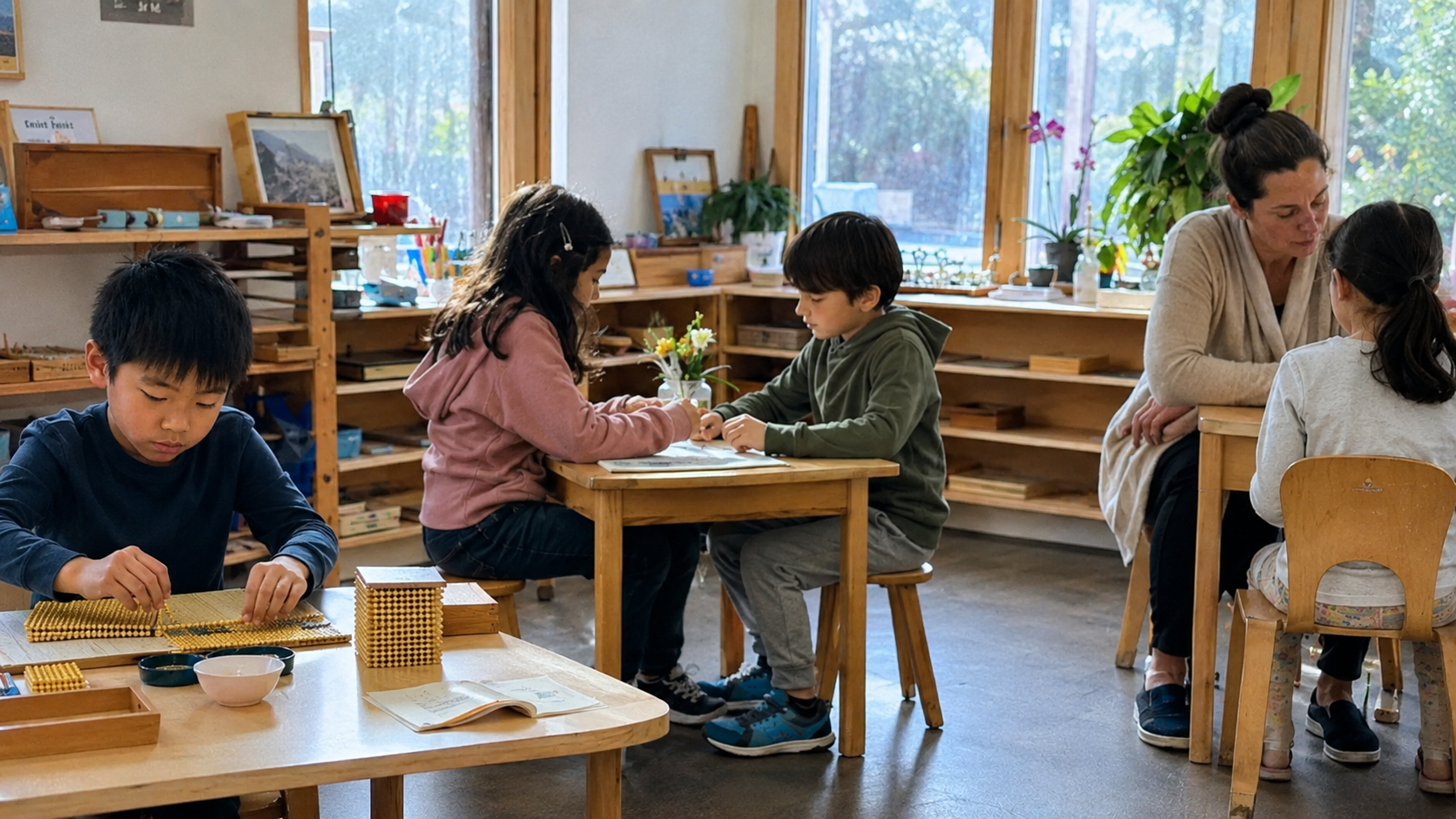
At Ignite Entrepreneurship Academy, our Montessori classrooms are intentionally designed differently. Rather than dividing the day into many short periods, students spend significant time in uninterrupted work cycles where they can fully engage in meaningful learning.
This approach isn't simply a scheduling preference—it's based on more than a century of Montessori philosophy and supported by modern research on how children learn best.
What Is a Montessori Work Cycle?
One of the defining characteristics of Montessori education is the uninterrupted work cycle.
Rather than moving every 30 minutes to a new subject, students have extended blocks of time to:
- Receive one-on-one lessons
- Practice newly learned skills
- Explore concepts independently
- Collaborate with classmates
- Solve complex problems
- Reflect on their learning
Teachers are actively guiding students throughout this time, but the pace is driven by meaningful engagement instead of the clock.
The American Montessori Society explains that uninterrupted work periods allow children to develop concentration, independence, intrinsic motivation, and responsibility—qualities that are difficult to cultivate when students are constantly transitioning between activities.
Why Deep Concentration Matters
Think about the last time you were completely absorbed in a project.
Maybe you were assembling furniture.
Writing an important report.
Learning a new skill.
You probably didn't do your best thinking during the first five minutes.
It likely took time to eliminate distractions, organize your thoughts, and become fully immersed.
Children experience concentration the same way.
Educational psychologist Mihaly Csikszentmihalyi, known for his research on the concept of flow, found that people learn and perform best when they become deeply engaged in challenging, meaningful work. Interruptions break that state of concentration, requiring the brain to continually restart the learning process.
Longer learning blocks give students the opportunity to reach that level of sustained focus.
Every Transition Has a Cost
Transitions are necessary, but they aren't free.
Each time students stop one activity and begin another, they must mentally shift their attention.
Researchers refer to this as attention residue or task switching.
Even adults experience reduced productivity when constantly switching between tasks. Children, whose executive function skills are still developing, often require even more time to refocus.
A classroom with ten or more transitions each day may lose a surprising amount of instructional time simply helping students shift from one activity to the next.
Longer work cycles reduce those interruptions and allow students to spend more of their day actually learning.
Students Learn at Different Speeds
One of the greatest strengths of Montessori education is recognizing that children develop differently.
Some students quickly understand multiplication but need additional time with reading comprehension.
Others excel in writing while taking longer to master fractions.
Traditional schedules often require everyone to move on together.
Montessori classrooms offer more flexibility.
During an extended work cycle, a teacher may introduce a new lesson to one student, work with a small group practicing another concept, while other students independently continue work they've already begun.
This individualized approach allows children to experience success at their own pace without unnecessary comparison.
Longer Work Periods Build Executive Function
Executive function refers to the mental skills that help us:
- Plan
- Organize
- Prioritize
- Focus attention
- Manage time
- Complete tasks
According to the Center on the Developing Child at Harvard University, these skills are among the strongest predictors of future academic achievement and overall life success.
Extended learning blocks naturally strengthen executive function because students learn how to:
- Decide what work to complete
- Manage their time wisely
- Finish challenging tasks
- Return to unfinished work
- Solve problems independently
Instead of relying on constant reminders from teachers, students gradually develop ownership of their learning.
Learning Becomes More Meaningful
Imagine trying to build a model bridge in only fifteen minutes.
Or write a thoughtful story in twenty minutes.
Or conduct a science experiment that must stop halfway through because the bell rings.
Many worthwhile learning experiences simply require more time.
Extended work cycles allow students to move beyond memorizing information and into applying it.
Rather than asking, "What's the right answer?"
Students begin asking:
- Why does this work?
- What happens if I change this?
- How can I improve my solution?
- Is there another way to solve this problem?
Those are the kinds of questions that develop critical thinking.
Independence Doesn't Happen Overnight
One of Ignite's goals is to help students become confident, independent learners.
Independence isn't taught through lectures.
It's developed through practice.
During longer work periods, students learn to:
- Select appropriate work
- Gather materials
- Stay organized
- Ask thoughtful questions
- Solve problems
- Clean up responsibly
These daily habits gradually become lifelong skills.
How This Supports Entrepreneurship
Ignite Entrepreneurship Academy combines Montessori principles with entrepreneurial thinking.
That combination works especially well because entrepreneurship requires many of the same habits developed during uninterrupted work cycles.
Entrepreneurs rarely solve important problems in thirty-minute increments.
They research.
Prototype.
Revise.
Collaborate.
Reflect.
Improve.
Students who regularly experience deep work develop many of these same habits long before entering college or the workforce.
What Parents Often Notice
Families are sometimes surprised by what they hear after school.
Instead of saying,
"We switched classes seven times today,"
students often share stories like:
- "I finally figured out that math problem."
- "Our team solved our engineering challenge."
- "I finished building my project."
- "I helped another student."
- "I kept working until I got it."
Those conversations reflect something deeper than completing assignments.
They show students taking ownership of their learning.
Frequently Asked Questions
Do students receive instruction during work cycles?
Absolutely. Teachers provide individual lessons, small-group instruction, observation, coaching, and feedback throughout the work period. Students are never simply "left on their own."
Doesn't every child need structure?
Yes. Montessori classrooms are highly structured—but the structure is designed around purposeful learning rather than frequent bells and transitions.
Are longer work periods appropriate for younger children?
Yes. In fact, younger children often become deeply engaged when given uninterrupted time to explore meaningful activities. Montessori classrooms are intentionally prepared to support age-appropriate independence.
Does this prepare students for middle school?
Yes. Students develop organization, time management, self-direction, and problem-solving skills that help them succeed as academic expectations increase.
Final Thoughts
Every school schedule reflects a philosophy of learning.
Some emphasize covering as much material as possible in short blocks of time.
At Ignite Entrepreneurship Academy, we believe meaningful learning deserves time.
By giving students uninterrupted opportunities to think deeply, solve problems, collaborate with others, and receive individualized instruction, we help them develop more than academic knowledge.
We help them build focus.
Independence.
Perseverance.
And a genuine love of learning.
Those are skills that extend far beyond elementary school—and they'll serve students for the rest of their lives.
Research & Further Reading
- American Montessori Society. The Montessori Classroom. https://amshq.org
- Harvard Center on the Developing Child. Executive Function & Self-Regulation. https://developingchild.harvard.edu
- Mihaly Csikszentmihalyi. Flow: The Psychology of Optimal Experience. Harper & Row, 1990.
- National Center for Montessori in the Public Sector. https://www.public-montessori.org
Ready to join IEA?
Give your child a Montessori foundation and entrepreneurial wings. Apply to the Ignite Entrepreneurship Academy enrollment lottery today.
Apply to the lottery